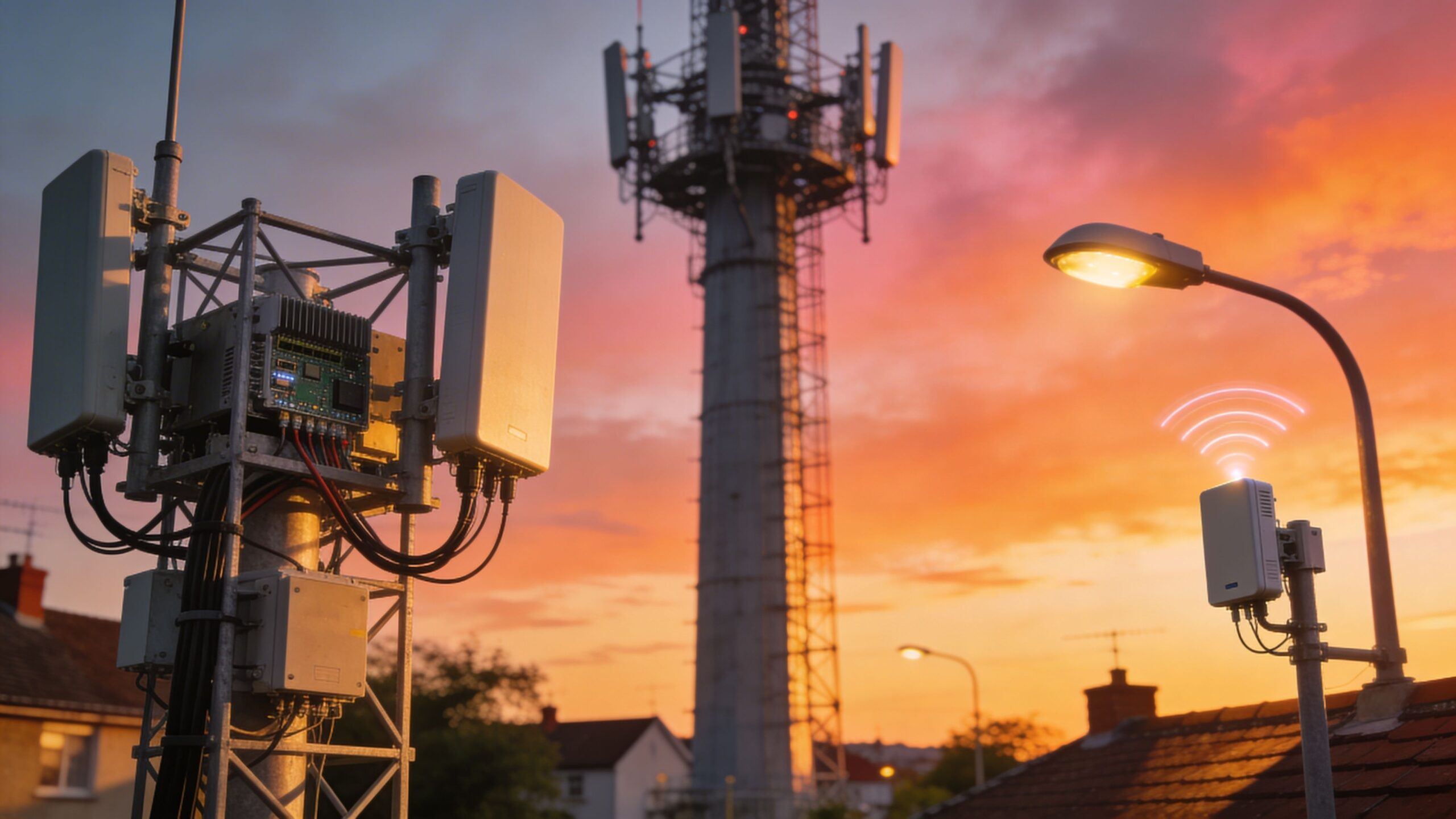
Every time your phone shows full bars—or frustratingly drops to one—you are witnessing the outcome of a sophisticated network battle happening behind the scenes. At the heart of this system are two key players: small cell antennas and macro towers. These two technologies work together, sometimes in competition and often in collaboration, to deliver the mobile signal you rely on every day. As wireless demand continues to surge, especially in dense urban environments, the traditional dominance of macro towers is being challenged by the rapid rise of small cell infrastructure. Yet this is not a story of replacement—it is a story of evolution. Each technology has its strengths, its limitations, and its ideal role within a modern network.
A: It is a tall, high-power cell site designed to cover large areas with broad wireless service.
A: It is a lower-power wireless node placed closer to users to improve capacity and targeted coverage.
A: Small cells often deliver faster speeds in dense areas, but macro towers remain essential for wide coverage.
A: Macro towers cover much larger areas than small cells.
A: The network moves your device between layers based on location, signal strength, load, and mobility needs.
A: No. They usually complement macro towers rather than replace them.
A: Cities have heavier traffic, more obstacles, and more demand for localized capacity improvements.
A: Large distances and lower population density make broad-coverage towers more practical.
A: Yes. Most modern mobile networks are layered and use both extensively.
A: Usually both at different times—macro towers for reach and continuity, small cells for targeted speed and capacity.
Macro Towers: The Giants That Started It All
Macro towers have long been the foundation of cellular networks. These tall, highly visible structures—often rising hundreds of feet into the air—are designed to cover wide geographic areas with a single installation. Their height allows signals to travel over long distances, making them ideal for providing baseline coverage across cities, highways, and rural regions.
A macro tower typically supports multiple antennas arranged in sectors, each covering a portion of the surrounding area. This design allows the tower to serve thousands of users simultaneously, making it a powerful tool for broad coverage. In rural areas, where population density is low, macro towers are especially efficient, delivering connectivity across miles of open land.
Even in urban environments, macro towers remain essential. They act as the backbone of the network, ensuring that users maintain a connection even when smaller, localized systems are unavailable. Without macro towers, there would be no foundational layer to support widespread mobile communication.
However, as data demand has grown, the limitations of macro towers have become more apparent. Their wide coverage areas can lead to congestion, especially in densely populated مناطق where thousands of devices compete for bandwidth within a single sector. This challenge has paved the way for a new approach to network design.
Small Cell Antennas: The Rise of Hyper-Local Connectivity
Small cell antennas represent a shift toward a more distributed and localized network model. Unlike macro towers, which prioritize range, small cells focus on proximity. These compact devices are typically mounted on streetlights, utility poles, and building facades, bringing the network closer to the user. By operating within a smaller نطاق, small cells can deliver higher data speeds and more consistent performance. They are particularly effective in areas with high user density, such as downtown districts, stadiums, and transportation hubs. In these environments, small cells help alleviate congestion by offloading traffic from macro towers.
One of the key advantages of small cells is their ability to support high-frequency spectrum, including millimeter wave bands used in advanced 5G networks. These frequencies offer incredible speed but have limited range, making small cell deployment essential for unlocking their full potential.
The result is a network that feels faster, more responsive, and better suited to modern digital demands. Small cells do not replace macro towers—they enhance them, creating a layered system that balances coverage and capacity.
Coverage vs Capacity: The Core Difference Explained
At the heart of the small cell versus macro tower debate is a fundamental distinction between coverage and capacity. Macro towers excel at covering large areas, ensuring that users can connect to the network even in remote or sparsely populated regions. Their strength lies in reach and reliability. Small cells, on the other hand, are designed to increase capacity. By serving smaller groups of users within a محدد area, they can deliver higher data rates and reduce network congestion. This makes them ideal for environments where demand is concentrated and constantly fluctuating. In practical terms, this means that macro towers provide the safety net of connectivity, while small cells deliver the performance enhancements that modern users expect. When you experience fast download speeds in a busy city center, it is often the result of small cell deployment. When you maintain a signal on a remote highway, it is likely thanks to a macro tower. This complementary relationship highlights the importance of both technologies in building a robust and efficient network.
Urban vs Rural: How Location Shapes Network Strategy
Geography plays a critical role in determining whether small cells or macro towers take precedence. In rural areas, where users are spread out over large distances, macro towers are the most practical solution. Their ability to cover wide مناطق with minimal infrastructure makes them cost-effective and efficient.
In contrast, urban environments present a completely different set of challenges. High population density, complex building layouts, and heavy data usage require a more nuanced approach. This is where small cells come into their own, providing targeted coverage and boosting capacity in areas where macro towers alone would struggle.
Cities often rely on a hybrid model, combining the broad reach of macro towers with the precision of small cells. This layered approach ensures that users receive consistent coverage while also benefiting from high-speed connectivity in high-demand areas.
As urbanization continues to accelerate, the importance of small cell deployment will only grow. At the same time, macro towers will remain essential for maintaining the underlying network structure that supports these localized enhancements.
Speed, Latency, and the 5G Advantage
The transition to 5G has amplified the differences between small cells and macro towers, particularly in terms of speed and latency. While macro towers can support 5G technology, their performance is often limited by distance and user load. Small cells, with their close proximity to users, are better positioned to deliver the ultra-fast speeds and low latency that define the 5G experience.
Latency, or the time it takes for data to travel between a device and the network, is a critical factor for applications such as gaming, video conferencing, and autonomous systems. Small cells reduce latency by shortening the distance that signals must travel, resulting in more responsive connections.
Speed is another area where small cells shine. By using higher-frequency spectrum and serving fewer users per cell, they can achieve significantly higher data rates. This makes them ideal for supporting bandwidth-intensive applications, from high-definition streaming to augmented reality.
Macro towers still play a role in 5G networks, particularly in providing coverage across larger areas. However, the full potential of 5G is realized through the dense deployment of small cells, which bring high-performance connectivity directly to the user.
Infrastructure, Cost, and Deployment Challenges
While the benefits of small cells are clear, their deployment comes with its own set of challenges. Building a dense network of small cells requires significant investment in equipment, installation, and maintenance. Each unit must be connected to the network through a reliable backhaul, often requiring fiber infrastructure. Permitting and zoning can also be complex, particularly in urban areas where space is limited and regulations are strict. Integrating small cells into existing infrastructure requires careful planning and coordination with local authorities. Macro towers, by comparison, involve higher upfront costs but require fewer installations to cover large areas. Once built, they can serve thousands of users with relatively low maintenance requirements. This makes them a cost-effective solution for wide-area coverage. The choice between small cells and macro towers is not simply a matter of technology—it is also a matter of economics and logistics. Network providers must balance performance goals with practical considerations, ensuring that investments deliver maximum value.
The Future Network: A Unified Approach to Connectivity
As mobile networks continue to evolve, the distinction between small cells and macro towers is becoming less about competition and more about collaboration. The future of connectivity lies in a unified approach that leverages the strengths of both technologies. In this vision, macro towers provide the foundational layer of coverage, ensuring that users remain connected مهما كانت الظروف. Small cells build on this foundation, delivering high-speed, low-latency performance where it is needed most. Together, they create a network that is both گسترده and precise, capable of adapting to the demands of modern الحياة. Advances in network management, artificial intelligence, and edge computing will further enhance this integration, allowing systems to dynamically allocate resources and optimize performance in real time. The result will be a more intelligent and responsive network that can support everything from everyday communication to emerging technologies. Ultimately, the question is not whether small cells or macro towers power your mobile signal—it is how they work together to create a seamless and reliable experience. In a world that depends on constant connectivity, this partnership is the key to unlocking the full potential of wireless technology.