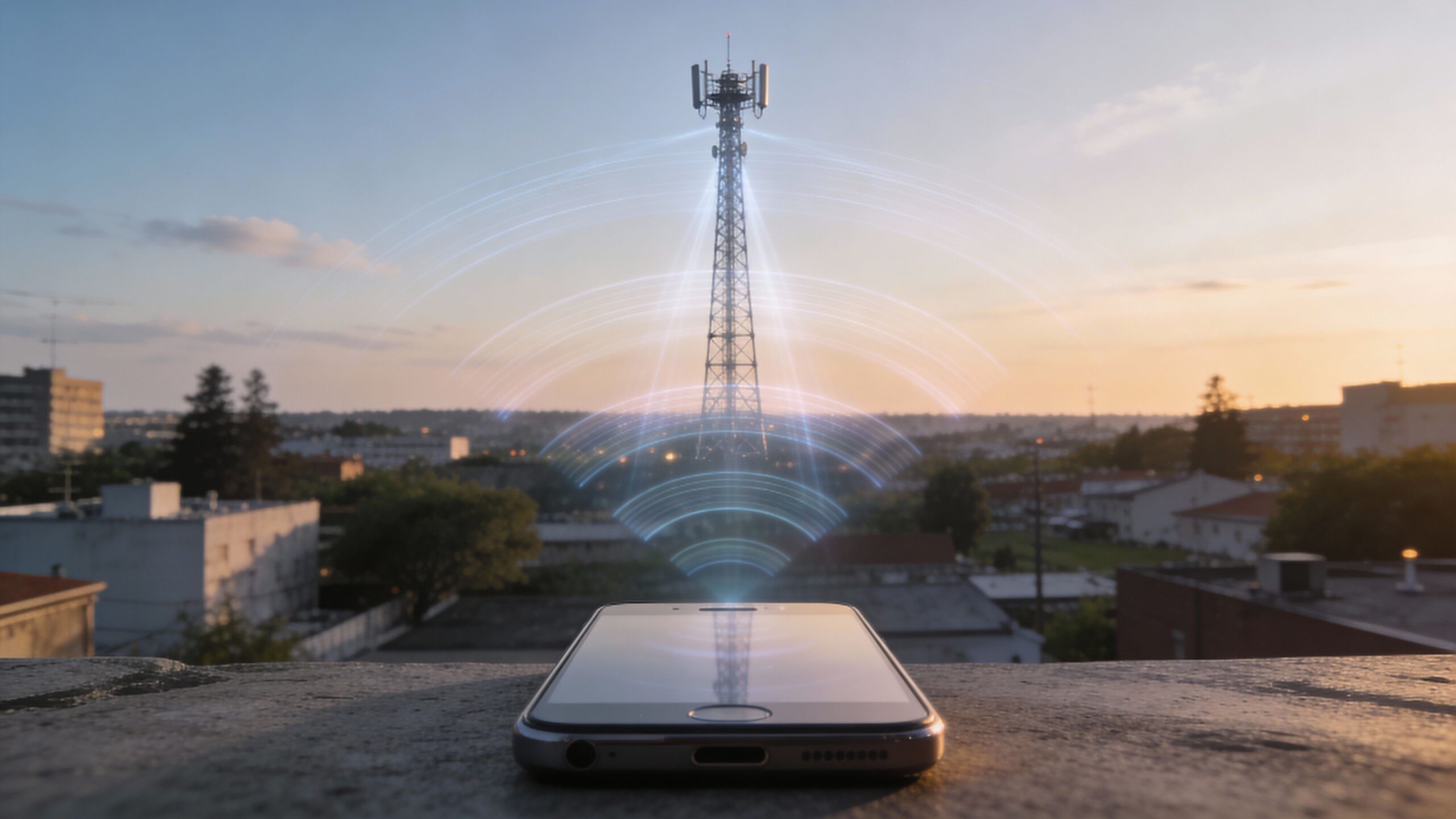
The moment you tap your screen and see signal bars appear, your phone has already completed a complex digital handshake with the world around it. Before any text message, call, or video stream can happen, your smartphone must first announce itself to the nearest cell tower and prove that it belongs on the network. This process begins the instant your device powers on or moves into a new coverage area. Your phone listens quietly, scanning the airwaves for broadcast signals that towers constantly emit. These signals act like beacons, advertising a network’s identity, available frequencies, and basic rules for communication. Once your phone selects the strongest and most compatible tower, it sends a request containing temporary identification information. This is not your phone number in plain form, but a coded identity designed to protect your privacy. The tower forwards this request deeper into the carrier’s core network, where authentication systems verify that your SIM is valid and authorized. Only after this verification does the network grant your phone permission to transmit data. In a fraction of a second, a secure session is established, encryption keys are exchanged, and your device becomes an active participant in the mobile ecosystem. From that point on, every interaction your phone has with the network is tracked, timed, and managed to ensure efficiency and security.
A: Bars show strength (RSRP), not congestion or quality (SINR). A busy cell can be slow even with strong signal.
A: 5G adds more efficient radio tech (massive MIMO/beamforming) and can use wider channels—especially in mid-band/mmWave.
A: It transmits at higher power and searches harder for usable cells when towers are farther apart.
A: It’s the tower’s connection to the core/internet. Great 5G radios still feel slow if backhaul is limited.
A: A low-power mini tower that adds capacity/coverage in dense areas like downtown streets or stadiums.
A: Not quite—Wi-Fi calling integrates with your carrier number and emergency calling features more directly.
A: It uses a 5G core (not LTE-anchored), enabling different latency and advanced features where deployed.
A: mmWave is easily blocked by buildings, trees, and even your body—amazing speed, fragile coverage.
A: Your SIM identity stays the same; you authenticate through agreements and gateways between carriers.
A: Enable Wi-Fi calling and place your router well; for signal issues, a carrier-approved solution may help too.
Towers, Cells, and the Geography of Coverage
Cell towers are not just tall metal structures with antennas bolted on. They are carefully engineered access points that divide the world into manageable coverage zones known as cells. Each tower typically serves multiple cells, with antennas angled and tuned to cover specific geographic slices. This design allows networks to reuse the same radio frequencies in different locations without causing interference, dramatically increasing the number of users who can connect at once.
As you move through a city or along a highway, your phone is constantly evaluating signal quality from nearby cells. When it detects that a neighboring cell can provide a stronger or more stable connection, the network orchestrates a handoff. This transition is so seamless that you rarely notice it, even during a phone call or video stream. Behind the scenes, timing is critical. The network ensures that your data stream is synchronized across towers so that packets arrive in the correct order, preserving call quality and data integrity.
Urban areas often contain dense clusters of small cells mounted on rooftops, streetlights, or utility poles. These smaller installations handle high traffic volumes and fill coverage gaps created by buildings. In rural areas, fewer towers cover larger distances, trading capacity for reach. The same principles apply in both cases, but the network dynamically adjusts power levels, timing, and modulation schemes to match local conditions.
From Voice to Data: Turning Information Into Radio Waves
When you speak into your phone or load a webpage, your device converts that information into digital data. Voice is captured by a microphone, compressed using advanced codecs, and sliced into small packets. Data from apps follows a similar path, broken into chunks that can be efficiently transmitted. These packets are then mapped onto radio signals using modulation techniques that encode information into changes in amplitude, frequency, or phase. The air interface between your phone and the tower is one of the most challenging parts of the system. Radio waves must compete with noise, reflections, and interference from countless other devices. To overcome this, modern networks use adaptive modulation and coding. When conditions are good, your phone transmits more bits per signal, achieving higher speeds. When conditions degrade, the network automatically switches to more robust schemes that prioritize reliability over speed.
Timing is equally important. Multiple phones share the same frequencies, so the network assigns precise time slots or resource blocks to each device. Your phone transmits only during its allotted moments, then listens for incoming data. This rapid back-and-forth happens thousands of times per second, creating the illusion of a continuous connection even though access is carefully scheduled.
The Core Network: The Brain Behind the Bars
While towers handle the radio connection, the true intelligence of a mobile network lives in the core. This is a vast digital infrastructure composed of servers, databases, and routing systems that manage authentication, mobility, billing, and data flow. Every packet your phone sends passes through this core before reaching the internet or another user.
When you place a call or open an app, the core network determines where that data needs to go. If you are calling another mobile user, the system locates their current cell and routes the packets accordingly. If you are accessing a website, the data is forwarded to internet gateways that connect the mobile network to the broader web. Throughout this journey, quality-of-service rules are applied to prioritize latency-sensitive traffic like voice and video over less time-critical data.
Mobility management is another crucial role of the core. As you move, the network updates your location at a high level, tracking which region or cluster of cells you are in. This allows incoming calls and messages to be delivered without broadcasting your location to every tower. The result is efficient routing that balances responsiveness with privacy.
Security in Motion: Encryption and Authentication
Mobile networks are designed with security woven into every layer. From the moment your phone connects, encryption protects the data traveling through the air. This prevents eavesdroppers from intercepting calls or reading messages. Encryption keys are regularly refreshed, reducing the risk of long-term exposure even if a key were somehow compromised.
Authentication is equally important. The SIM card in your phone contains secret credentials shared only with your carrier. These credentials are never transmitted directly. Instead, challenge-response protocols prove your identity without revealing sensitive information. This process ensures that only authorized devices can access the network and that fraudulent activity is quickly detected.
As data moves deeper into the network, additional security measures come into play. Firewalls, intrusion detection systems, and traffic monitoring protect against attacks and abuse. Even when your data exits the mobile network and enters the public internet, secure tunnels and filtering systems help maintain integrity and reliability. The goal is to make security invisible to the user while remaining resilient against constantly evolving threats.
Speed, Capacity, and the Art of Network Optimization
Delivering fast and reliable mobile service is a continuous balancing act. Networks must accommodate millions of users with varying demands, all while operating within limited radio spectrum. To achieve this, carriers rely on sophisticated optimization techniques that adjust network behavior in real time. Load balancing spreads traffic across available cells, preventing congestion in hotspots. Beamforming focuses radio energy toward individual devices, improving signal quality and reducing interference. Carrier aggregation combines multiple frequency bands to increase throughput, allowing your phone to use several channels at once. These techniques work together to squeeze maximum performance out of the available infrastructure. Backhaul capacity is another critical factor. Towers are connected to the core network through high-speed fiber or microwave links. If these connections become saturated, performance suffers regardless of radio quality. Engineers constantly monitor usage patterns, upgrading links and deploying additional resources where demand grows. The result is a network that evolves continuously, often without users realizing how much effort goes into keeping those signal bars steady.
What Happens When You Move, Stream, or Call at Speed
One of the most impressive feats of mobile networking is maintaining service while you move at high speeds. Whether you are walking, driving, or riding a train, your phone and the network collaborate to anticipate changes in signal conditions. Measurement reports sent by your device inform the network about neighboring cells, allowing handoffs to be prepared in advance. Streaming video adds another layer of complexity. Data must arrive in a steady flow to avoid buffering, even as network conditions fluctuate. Adaptive streaming protocols adjust video quality on the fly, requesting higher or lower resolution segments based on current throughput. This constant feedback loop keeps playback smooth while making efficient use of network resources.
Voice calls demand low latency and minimal packet loss. The network prioritizes these streams, reserving resources and applying error correction techniques to preserve clarity. Even as you cross cell boundaries, the system ensures that voice packets are delivered in order, preventing dropped calls and awkward silences. All of this coordination happens so quickly that the experience feels effortless, masking the extraordinary technical choreography beneath the surface.
The Road Ahead: How Mobile Networks Keep Evolving
Mobile networks are never finished. Each generation builds on the last, refining how data is transmitted, managed, and secured. As devices multiply and applications become more demanding, networks adapt by becoming more flexible and software-driven. Virtualized core components allow capacity to be scaled dynamically, while intelligent algorithms predict demand and adjust resources before congestion occurs. The future promises even tighter integration between devices and networks. Phones will become more aware of their environment, choosing the best connection paths automatically. Networks will respond with greater precision, tailoring performance to individual needs in real time. Despite these advances, the fundamental journey from tower to smartphone will remain rooted in the same principles of radio communication, coordination, and trust. Understanding how mobile networks actually work reveals a world of invisible infrastructure that supports modern life. Every swipe, call, and stream depends on an intricate system designed to be fast, secure, and reliable. The next time you glance at your phone and see those signal bars, you are looking at the visible tip of a vast and remarkably elegant technological achievement.