For years, 4G networks powered the modern mobile experience, enabling everything from video streaming to app-based economies. It felt fast, reliable, and revolutionary when it arrived. But as digital demand surged—driven by cloud computing, smart devices, and real-time applications—a new standard began to emerge. That standard is 5G, and it represents far more than just faster speeds. The transition from 4G to 5G is not simply an upgrade in performance. It is a complete transformation of the underlying infrastructure that supports wireless communication. While 4G was designed primarily for mobile internet, 5G is engineered for a fully connected world, where machines, vehicles, cities, and industries communicate continuously. To understand what really changed, it’s necessary to look beneath the surface and explore how networks themselves were rebuilt.
A: No, most carriers upgraded existing sites and layered 5G onto infrastructure that already supported 4G.
A: Wider spectrum use, more advanced antennas, denser capacity strategies, and a more software-driven core architecture.
A: No, it is also about capacity, latency, device density, flexibility, and support for new enterprise and IoT use cases.
A: Many early deployments were non-standalone and still depended on 4G infrastructure for important control functions.
A: It is a more complete 5G architecture that uses a 5G core instead of leaning as heavily on 4G anchors.
A: Dense high-capacity 5G service often benefits from more localized coverage nodes in busy areas.
A: No, 4G remains a major part of modern networks and still supports wide coverage, voice, and fallback connectivity.
A: Faster radios create bigger traffic demands, so strong backhaul is needed to carry that data beyond the site.
A: It is one part of the story, but mid-band expansion, better antennas, and core upgrades mattered more broadly.
A: In the best cases, users got better speeds, better performance in crowds, and more consistent support for modern connected services.
From Coverage to Capacity: A New Network Philosophy
4G networks were built with a clear goal in mind: provide widespread coverage with reliable data speeds. Towers were strategically placed to cover large geographic areas, using mid- and low-band frequencies that could travel long distances and penetrate buildings effectively. This approach allowed telecom providers to expand quickly while maintaining consistent service.
5G, however, shifts the focus from coverage to capacity. Instead of simply reaching more people, the network is designed to handle vastly more data, more devices, and more simultaneous connections. This change reflects how people and systems now use the internet. It’s no longer just about browsing or streaming; it’s about constant interaction between devices, applications, and services.
To support this shift, 5G networks use a layered architecture that combines different frequency bands. Lower frequencies still provide broad coverage, but higher frequencies are introduced to deliver extremely high data speeds in dense environments. This creates a more complex, but far more capable, network structure.
The Rise of Small Cells and Dense Infrastructure
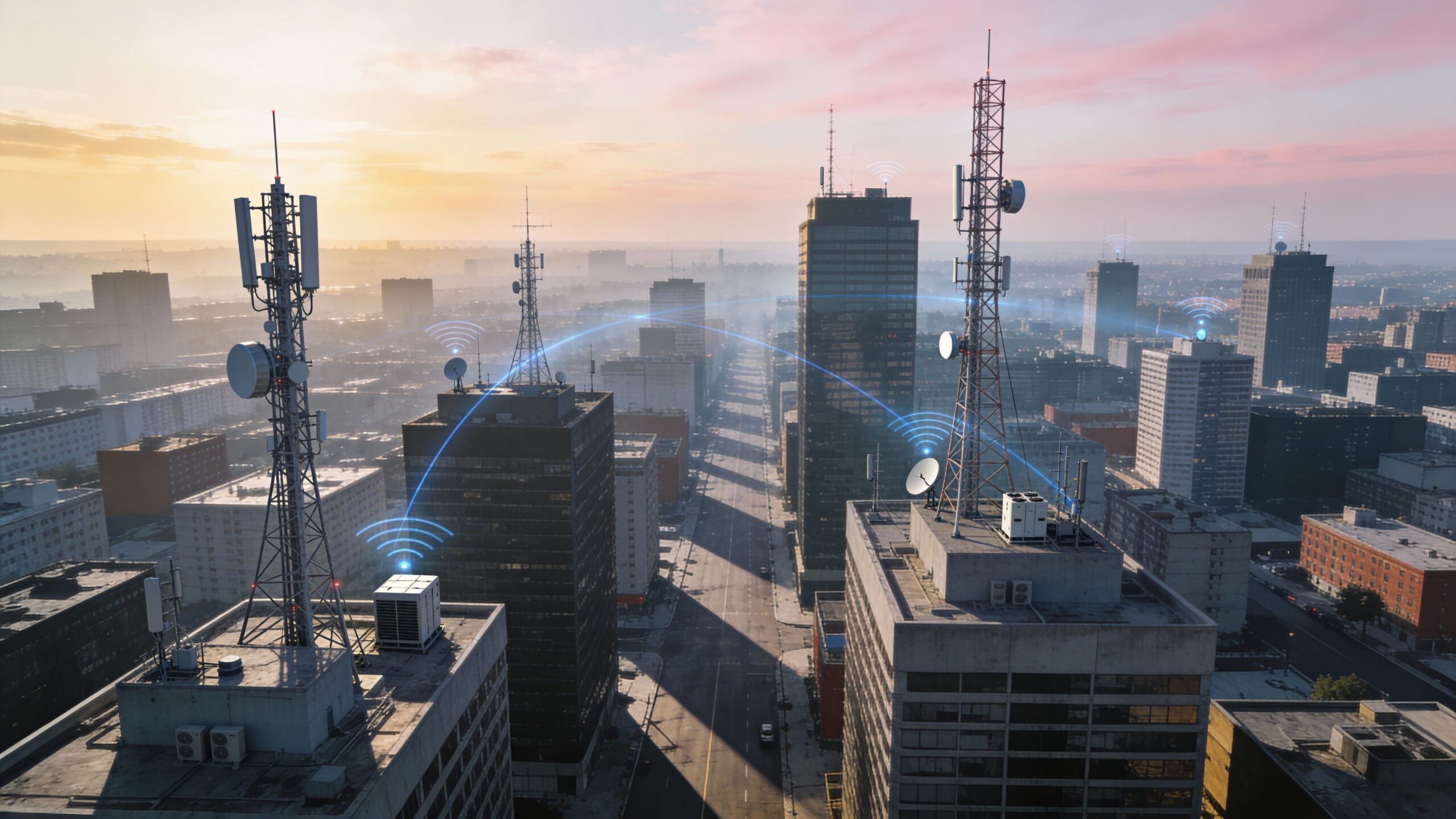
One of the most visible changes between 4G and 5G infrastructure is the dramatic increase in network density. Traditional 4G networks rely heavily on large cell towers that cover wide areas. These towers remain important in 5G, but they are no longer sufficient on their own.
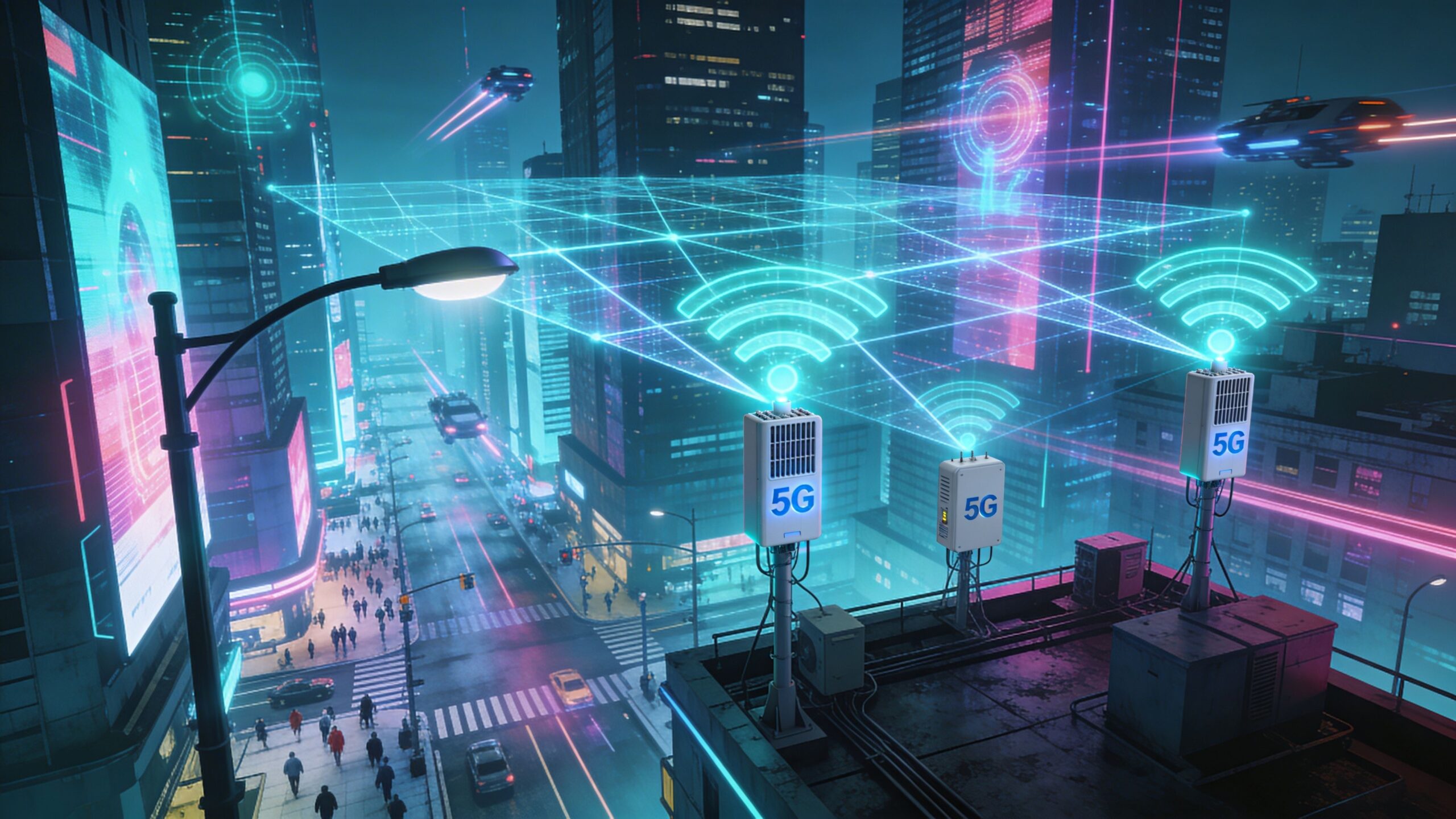
5G introduces the concept of small cells—compact base stations that can be installed on streetlights, buildings, and other urban structures. These small cells cover much smaller areas but deliver significantly higher capacity and speed. By deploying many of them throughout a city, networks can handle the massive data demands of modern users.
This dense infrastructure is especially important for high-frequency signals, which do not travel as far and are more easily blocked by obstacles. By placing small cells closer to users, the network ensures strong, reliable connections even in crowded environments.
The result is a shift from a few large towers to a distributed network of interconnected nodes, creating a more flexible and responsive system.
Spectrum Evolution: Unlocking New Frequencies
Another major change lies in how spectrum is used. 4G primarily operates in low- and mid-band frequencies, which offer a balance between range and speed. While effective, these frequencies are limited in capacity, especially as data usage continues to grow.
5G expands into new territory by utilizing high-band frequencies, often referred to as millimeter waves. These frequencies can carry enormous amounts of data, enabling ultra-fast speeds and low latency. However, they come with trade-offs, including shorter range and reduced ability to penetrate buildings.
To overcome these challenges, 5G networks combine multiple frequency bands into a unified system. Devices can switch between bands or use them simultaneously, depending on conditions. This dynamic approach allows the network to optimize performance in real time.
The introduction of new spectrum is one of the key reasons 5G can deliver such dramatic improvements in speed and capacity, but it also requires significant changes in infrastructure and deployment strategies.
A Smarter Radio Access Network
The radio access network, which connects devices to the rest of the system, has also evolved significantly. In 4G, this layer is relatively centralized, with base stations handling both signal transmission and processing tasks.
5G introduces a more flexible and intelligent design. Functions that were once tied to physical hardware are now virtualized, allowing them to run on software platforms. This enables operators to scale resources dynamically, adapt to changing demand, and deploy updates more quickly.
Technologies like massive multiple-input multiple-output systems further enhance performance by allowing antennas to send and receive multiple data streams simultaneously. Beamforming adds another layer of efficiency, directing signals toward specific users rather than broadcasting them in all directions.
These advancements make the radio access network more adaptive, efficient, and capable of supporting a wide range of applications.
The Core Network Reinvented
Perhaps the most profound transformation occurs in the core network. In 4G, the core is largely hardware-based, with dedicated systems handling tasks like routing, authentication, and policy management. While effective, this structure can be rigid and difficult to scale.
5G replaces this with a software-driven, cloud-native core. Functions are broken down into modular components that can be deployed across distributed data centers. This allows for greater flexibility, faster innovation, and improved efficiency.
One of the most important features introduced in 5G is network slicing. This capability allows operators to create multiple virtual networks within a single physical infrastructure. Each slice can be tailored to specific use cases, such as high-speed consumer data, low-latency industrial applications, or massive IoT deployments.
This level of customization was not possible with 4G and represents a fundamental shift in how networks are designed and managed.
Latency and Real-Time Performance
While speed often gets the most attention, latency is where 5G truly distinguishes itself. Latency refers to the time it takes for data to travel from one point to another. In 4G networks, latency is typically measured in tens of milliseconds, which is sufficient for most applications.
5G reduces latency dramatically, enabling near real-time communication. This is achieved through a combination of factors, including edge computing, improved network architecture, and more efficient data routing.
Edge computing plays a crucial role by moving processing closer to the user. Instead of sending data to distant data centers, it can be handled locally, reducing delays. This is particularly important for applications like autonomous vehicles, remote surgery, and interactive gaming, where even small delays can have significant consequences.
The focus on latency highlights how 5G is designed not just for faster downloads, but for entirely new types of experiences.
Powering a Connected Ecosystem
The infrastructure changes between 4G and 5G are driven by a broader vision: a fully connected ecosystem where everything from smartphones to industrial machines can communicate seamlessly. 4G laid the foundation for mobile connectivity, but 5G expands that vision to include a vast array of devices and use cases.
In a 5G world, smart cities can manage traffic and energy in real time. Factories can operate with precision automation. Healthcare systems can deliver remote care with unprecedented accuracy. These possibilities require a network that is not only fast, but also reliable, flexible, and scalable.
The infrastructure supporting this ecosystem must handle diverse requirements, from high-bandwidth streaming to low-power sensor networks. 5G achieves this through its layered architecture, intelligent design, and advanced capabilities.
The New Standard of Connectivity
The transition from 4G to 5G represents one of the most significant technological shifts of the modern era. It is not just about faster phones or better streaming, but about reimagining how networks function at every level. From denser infrastructure and expanded spectrum to software-driven cores and ultra-low latency, every component of the network has been redesigned to meet the demands of a connected future. These changes enable new applications, improve efficiency, and open the door to innovations that were once considered out of reach. As 5G continues to expand, its impact will become even more apparent. The invisible systems that power our daily lives are evolving, becoming more intelligent and more capable with each advancement. Understanding what changed between 4G and 5G offers a glimpse into that future—a world where connectivity is not just faster, but fundamentally transformed.