Seeing full bars on your phone creates a powerful expectation that everything should work flawlessly. Strong signal bars feel like a promise of fast downloads, smooth streaming, and instant responses. Yet almost everyone has experienced the frustration of staring at full bars while a webpage crawls, a video buffers endlessly, or an app refuses to load. This disconnect happens because signal strength is only one small piece of a much larger system. Your phone may be hearing the tower loud and clear, but that does not mean the network can deliver data quickly or consistently at that moment.
A: Bars reflect signal strength; slow data is usually congestion, backhaul limits, or poor signal quality (interference).
A: Toggle Airplane Mode, switch 5G/LTE, and move a short distance to trigger a better cell/band selection.
A: Peak-hour congestion—more people streaming and scrolling on the same towers.
A: Yes—some plans are deprioritized during congestion, and some have throttles after usage thresholds.
A: Streaming buffers and tolerates latency; web browsing is latency-sensitive and feels “stuck” when ping is high.
A: Not always—some 5G bands prioritize coverage, and LTE can be faster if the 5G layer is congested or unstable.
A: Compare with another device, test at a different time, and check if ping/latency is high while bars stay strong.
A: Often—VPN routes can add latency or trigger traffic shaping, making performance feel slower.
A: You may switch to a different sector or small cell with different load and band availability.
A: Strong Wi-Fi + Wi-Fi Calling for voice, and consider a different carrier if your area is consistently congested.
Signal Strength and Data Speed Are Not the Same Thing
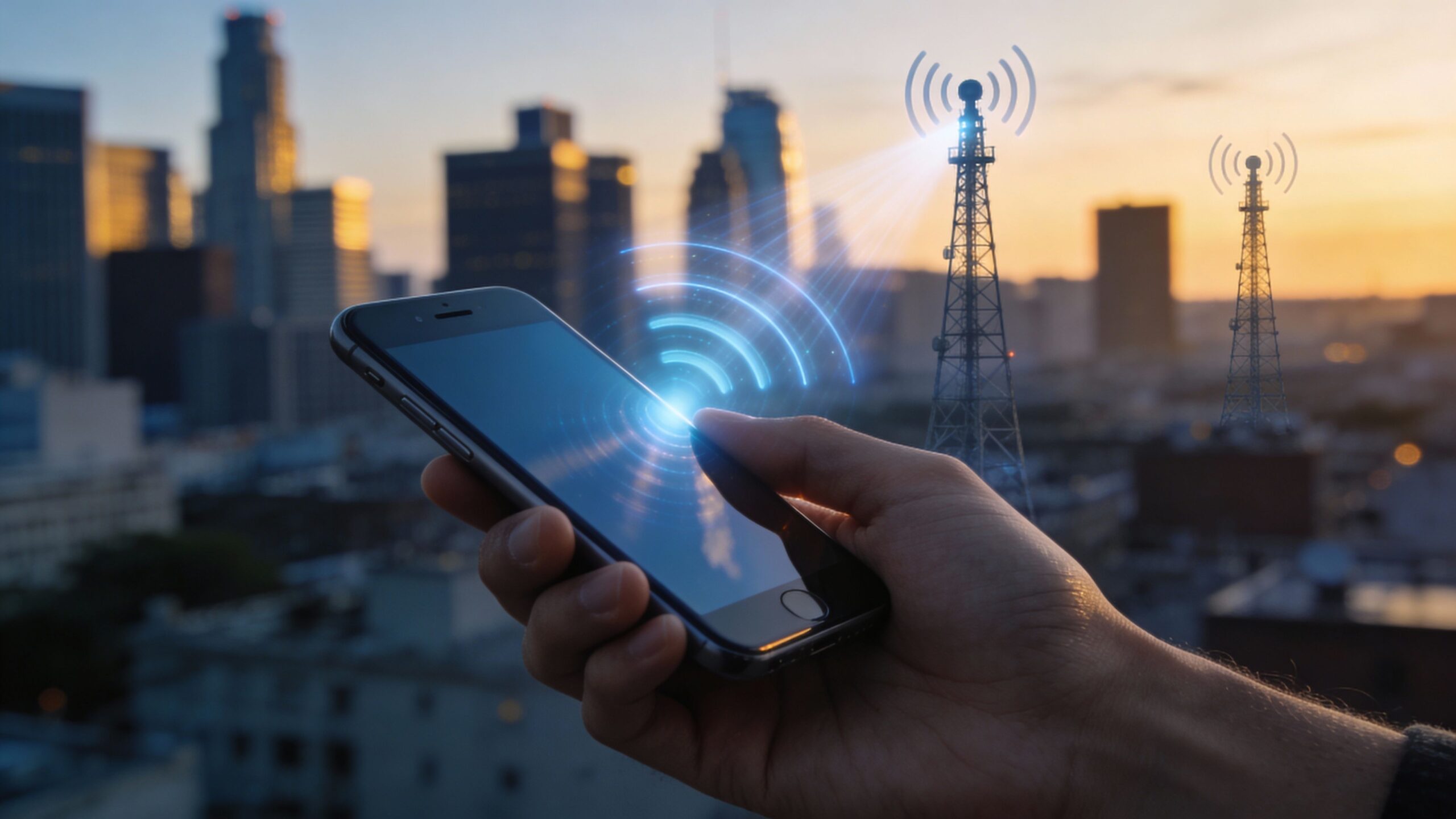
Signal strength measures how well your phone can communicate with a nearby cell tower using radio waves. Data speed, on the other hand, depends on how much information the network can send and receive once that connection exists. Think of signal strength as the clarity of a phone call, while data speed is how fast the conversation can happen. You can hear someone perfectly but still be forced to speak slowly. Full bars indicate a clean radio connection, but they say nothing about how busy the network is, how much bandwidth is available, or how efficiently data is being routed behind the scenes.
Network Congestion Is the Silent Bottleneck
One of the most common reasons for slow data with full bars is congestion. Every cell tower serves many devices at once, and its total capacity is limited. When too many phones are requesting data simultaneously, the network must divide its resources among them. This often happens during rush hours, large public events, or in densely populated areas. Even though your phone maintains a strong signal to the tower, the network may only be able to deliver small bursts of data at a time. To the user, this feels like inexplicable slowness despite excellent reception.
Your Phone Is Competing for Priority
Not all data requests are treated equally. Mobile networks constantly prioritize traffic based on factors such as subscription plans, network policies, and current conditions. Some users may receive higher priority during congestion, while others are temporarily slowed down. Background processes on your own phone can also compete for bandwidth, silently consuming data while you attempt to load something else. Full bars simply mean your phone is connected, not that it is first in line to receive data. When many devices are competing at once, speed can drop dramatically even though signal strength remains high.
The Hidden Impact of Distance and Direction
Even with full bars, your phone may not be in an ideal position relative to the tower. Signal strength indicators often round up, masking subtle weaknesses in signal quality. Interference from nearby buildings, vehicles, or even other electronic devices can degrade how efficiently data is transmitted. Your phone may hear the tower clearly but struggle to send information back at the same quality. This imbalance can slow data transfers without affecting the bar display. Small changes in orientation, location, or environment can influence how well data flows in both directions.
Modern Networks Are Constantly Switching Paths
Today’s mobile networks are incredibly dynamic. Your phone frequently switches between different frequency bands and technologies to optimize performance. These transitions are usually seamless, but they can introduce brief slowdowns as the network recalculates the best path for your data. Higher-speed connections often rely on higher-frequency signals that are more sensitive to obstacles and interference. When conditions change, your phone may cling to a strong signal that offers lower real-world speeds rather than switching immediately. During these moments, full bars can coexist with sluggish performance.
Apps, Servers, and the Internet Beyond the Tower
Slow data is not always caused by the mobile network itself. Once your data leaves the cell tower, it must travel through the broader internet to reach servers operated by apps and websites. If those servers are overloaded or experiencing issues, your connection will feel slow regardless of signal strength. Apps may also behave inefficiently, retrying requests or loading unnecessary resources. From your phone’s perspective, everything looks fine at the signal level, but the delay is happening far beyond the reach of the bars on your screen.
Why Understanding This Changes Your Expectations
Knowing why your phone can have full bars but slow data reshapes how you interpret mobile performance. Bars are a measure of connection, not a guarantee of speed. Data flows through a crowded, constantly shifting system that balances millions of users, devices, and decisions every second. When speeds drop, it is rarely because your phone or signal has failed. Instead, it is a reflection of how complex and shared modern mobile networks truly are. Understanding this helps turn frustration into clarity, revealing that even with full bars, your phone is navigating a far bigger story than it lets on.